15.3 Using coroutines to describe algorithms
In this section, we show examples of how to use coroutines to describe a certain class of algorithms often referred to as interlocked sequential execution stacks.
A generator is a coroutine capable of producing a sequence of values. A new value is produced for each resume of the coroutine. The next value depends on the sequence of previously generated values. We show how to define generators for computing the mathematical functions factorial. The main purpose of the factorial example is to illustrate how coroutines work.
We assume the reader is familiar with the factorial function, but here is a short description: The factorial of a non-negative integer N, denoted by N!, is the product of all positive integers less than or equal to N. First we show how to define factorial as a simple method:
   FactorialFunction(N: var integer) -> F: var integer:
      F := N
      loop: do
         if (N > 1) :then
            N := N - 1
            F := F * N
            restart(loop)
As can be seen, FactorialFunction computes the product N * (N – 1) * (N – 2) * … * 2 * 1.
Next we show how to define a generator that produce the sequence of factorial, 1!, 2!, 3!, …, N!, …. When the coroutine is resumed, it returns the next value in the sequence when it suspends.
   PlainFactorial: obj
      getNext -> R: var integer:
         resume(PlainFactorial)
         R := F
      F: var integer
      N: var integer
      F := 1
      cycle
         PlainFactorial.suspend
         N := N + 1
         F := F * N
When PlainFactorial is generated it executes statements until the first execution of PlainFactorial.suspend. A subsequent resume of PlainFactorial will continue execution after this suspend.
PlainFactorial.getNext will return the factorial of 1 which is 1. Subsequent resumes will return the next factorial as shown below:
UsingPlainFactorial: obj
   PlainFactorial: obj
      -"-
   V: var integer
   V := PlainFactorial.getNext -- V = 1
   V := PlainFactorial.getNext -- V = 2
   V := PlainFactorial.getNext -- V = 6
   V := PlainFactorial.getNext -- V = 24
The next figure shows a snapshot of the execution of UsingPlainFactorial where:
PlainFactorialhas been generated and suspended execution during the first iteration ofcycle.- The read arrow –> shows that
PlainFactorialis suspended just before the statementN := N + 1. - The point of execution in
UsingPlainFactorialis before the first statementV := PlainFactorial.nextas indicated by the read arrow ==>. - A read arrow of the form ==> shows the active point of execution.
- A read arrow of the form –> show the point of suspension of a coroutine.
The OSD in the right column illustrates what UsingPlainFactorial is currently executing and that PlainFactorial is suspended.
UsingPlainFactorial: obj
   PlainFactorial: obj
      -"-
      F := 1
      cycle
         PlainFactorial.suspend
-->      N := N + 1
         F := F * N
    V: var integer
==> V := PlainFactorial.getNext
    V := PlainFactorial.getNext
    V := PlainFactorial.getNext
    V := PlainFactorial.getNext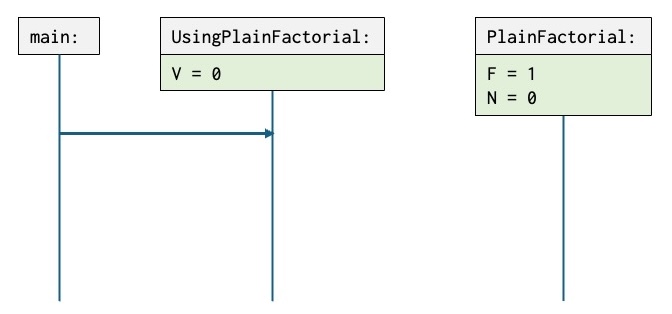
The OSD also shows the values of the variable V in UsingPlainFactorial, and the variables , F and N in PlainFactorial.
The next next scenario shows the situation:
PlainFactorial.getNexthas been executed byUsingPlainFactorial.getNexthas executedresume(PlainFactorial).- The next statement to be executed is
N := N + 1.
UsingPlainFactorial: obj
   PlainFactorial: obj
      getNext -> R: var integer:
         resume(PlainFactorial)
         R := F
      F: var integer
      N: var integer
      F := 1
      cycle
         PlainFactorial.suspend
==>      N := N + 1
         F := F * N
   V: var integer
   V := PlainFactorial.getNext
   V := PlainFactorial.getNext
   V := PlainFactorial.getNext
   V := PlainFactorial.getNext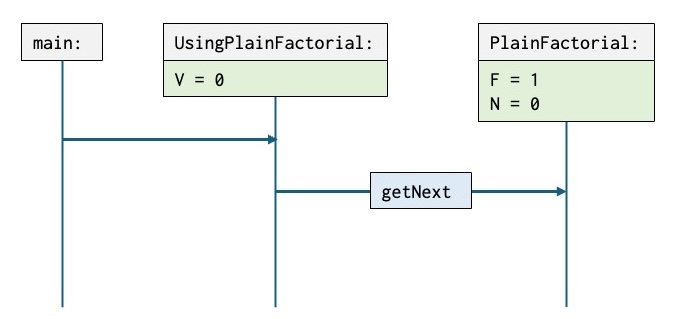
The next snapshot shows the situation after PlainFactorial has executed the two assignments statements, N := N + 1 and F := F * N, and executed a PlainFactorial.suspend during the second iteration of cycle:
PlainFactorialis suspended before the statementN := N + 1– as in the first figure above.- The active point of execution is in
UsingPlainFactorialbefore the second statementV := PlainFactorial.getNext. - The variables have been updated
V,FandNhave all new values.
UsingPlainFactorial: obj
   PlainFactorial: obj
      -"-
      cycle
         PlainFactorial.suspend
-->      N := N + 1
         F := F * N
    V: var integer
    V := PlainFactorial.getNext
==> V := PlainFactorial.getNext
    V := PlainFactorial.getNext
    V := PlainFactorial.getNext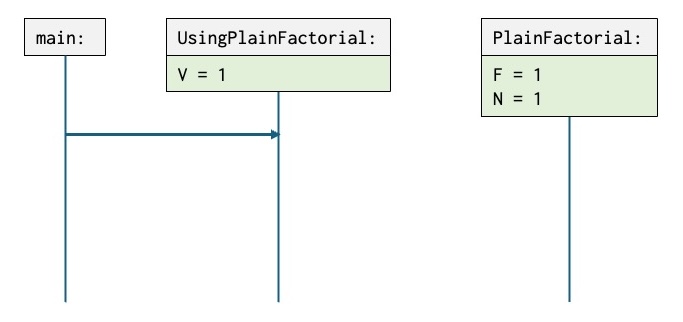
Execution of the second V := PlainFactorial.getNext resumes execution of PlainFactorial, which then generate the next factorial value. We don’t show a snapshot of this.
The next snapshot shows the situation after PlainFactorial has suspended:
PlainFactorialis as in previous snapshots suspended before the statementN := N + 1.- The current point of execution is in
UsingPlainFactorialbefore the third statementV := PlainFactorial.getNext. - The variables
V,FandNhave been updated.
UsingPlainFactorial: obj
   PlainFactorial: obj
      -"-
      cycle
         PlainFactorial.suspend
-->      N := N + 1
         F := F * N
    V: var integer
    V := PlainFactorial.getNext
    V := PlainFactorial.getNext
==> V := PlainFactorial.getNext
    V := PlainFactorial.getNext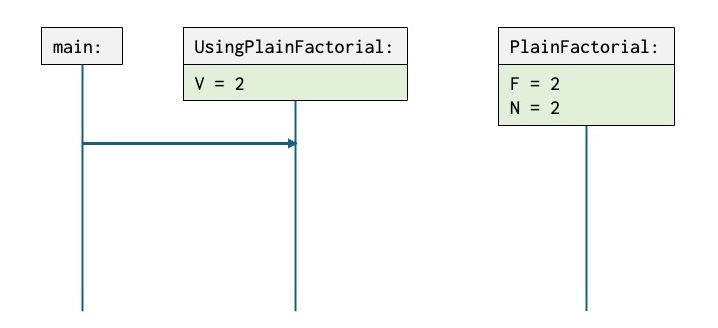
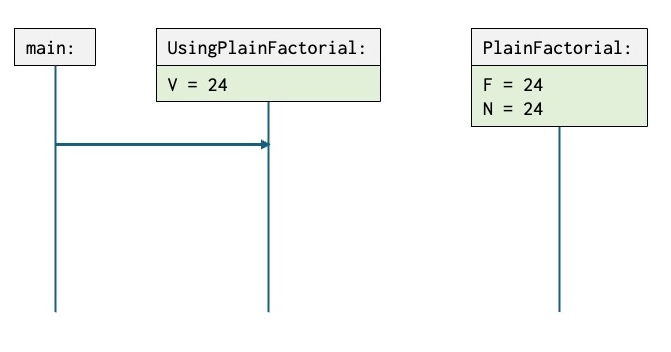
Finally we show a snapshot at the situation after execution of the last V := PlainFactorial.getNext:
PlainFactorialis (again) suspended before the statementN := N + 1.- The active point of execution is after the last statement.
- The variables
V,FandNhave been updated. V= 24 = 6!
UsingPlainFactorial: obj
   PlainFactorial: obj
      -"-
      cycle
         PlainFactorial.suspend
-->      N := N + 1
         F := F * N
    V: var integer
    V := PlainFactorial.getNext
    V := PlainFactorial.getNext
    V := PlainFactorial.getNext
    V := PlainFactorial.getNext
==>
Recursive factorial generator
Next we show a a version of a factorial generator using a recursive method instead of the loop implemented using cycle. As said the purpose is to show how coroutines work and not necessarily a recommended programming style.
  RecursiveFactorial: obj
      getNext -> R: var integer:
         resume(RecursiveFactorial)
         R := F
      F: var integer
      N: var integer
      next:
         RecursiveFactorial.suspend
         N := N + 1
         F := F * N
         next
      F := 1
      next
When RecursiveFactorial is generated it invokes the local method next, which suspends execution. Successive invocations of next resumes the coroutine and returns the next factorial (F) in the sequence.
The next figures shows snapshots of using RecursiveFactorial by the object UsingRecursiveFactorial:
UsingRecursiveFactorial: obj
   RecursiveFactorial: obj
      -"-
   V: var integer
   V := RecursiveFactorial.getNext -- V = 1
   V := RecursiveFactorial.getNext -- V = 2
   V := RecursiveFactorial.getNext -- V = 6
   V := RecursiveFactorial.getNext -- V = 24
The first snapshot how the situation after the objects UsingRecursiveFactorial and RecursiveFactorial have been generated:
RecursiveFactorialis suspended beforeN := N + 1in the method objectnext.- Note that
RecursiveFactorialhas been suspended while execution an instance of the methodnext. - The active point of execution is at the first
V := RecursiveFactorial.getNextinUsingRecursiveFactorial. - The values of the variables are
V = 0,F = 1andN = 0.
 UsingRecursiveFactorial: obj
    RecursiveFactorial: obj
       getNext -> R: var integer:
          resume(RecursiveFactorial)
          R := F
       F: var integer
       N: var integer
       next:
          RecursiveFactorial.suspend
-->       N := N + 1
          F := F * N
          next
       F := 1
       next
    V: var integer
==> V := RecursiveFactorial.getNext
    V := RecursiveFactorial.getNext
    V := RecursiveFactorial.getNext
    V := RecursiveFactorial.getNext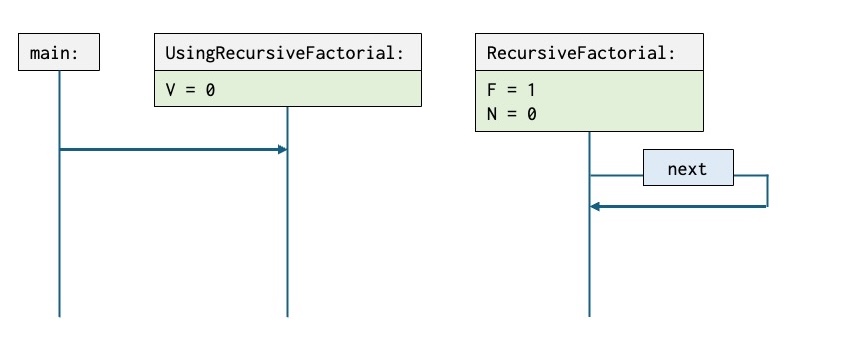
The next snapshot shows a situation after execution of the first RecursiveFactorial.getNext:
RecursiveFactorialhas been resumed.N := N + 1has been executed —N = 1.F := F * Nhas been executed —F = 1.- A recursive invocation of
nexthas been generated. - The active point of execution is at
RecursiveFactorial.suspendin thisnextmethod.
 UsingRecursiveFactorial: obj
    RecursiveFactorial: obj
       -"-
       next:
==>       RecursiveFactorial.suspend
          N := N + 1
          F := F * N
          next
       F := 1
       next
    V: var integer
    V := RecursiveFactorial.getNext
    V := RecursiveFactorial.getNext
    V := RecursiveFactorial.getNext
    V := RecursiveFactorial.getNext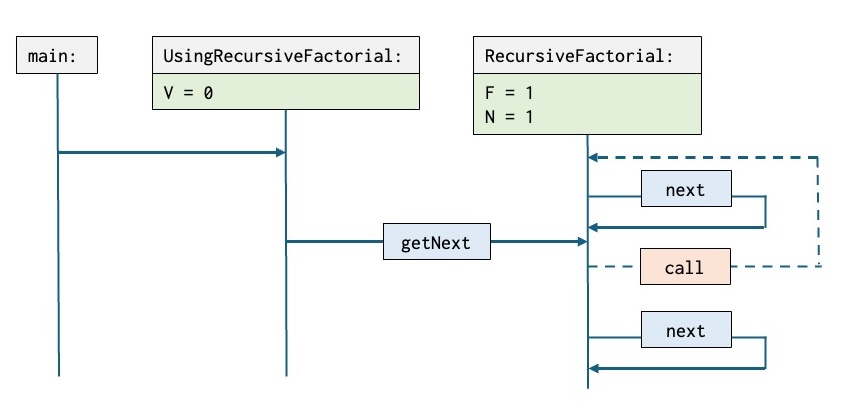
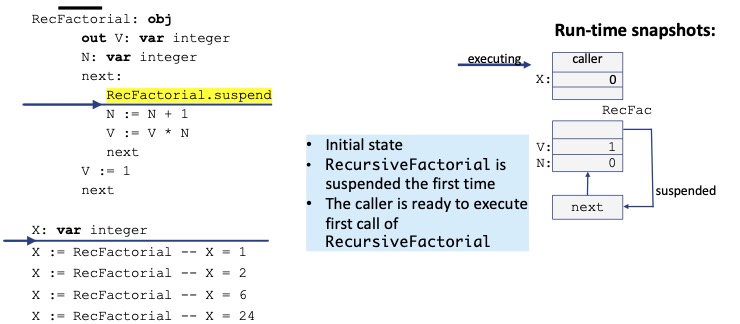
V := RecursiveFactorial.getNext -- V = 2V := RecursiveFactorial.getNext -- V = 6V := RecursiveFactorial.getNext -- V = 24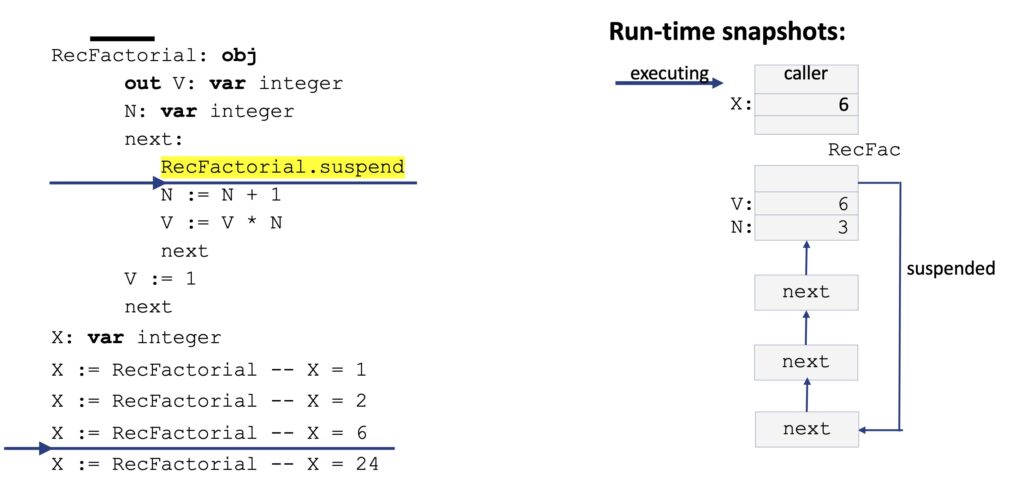
As can be seen, a suspend within next, suspends the whole execution stack and a resume resumes execution of the top element of the stack.
Merging binary search trees
The next example is more interesting. Here we show how to merge two binary search trees. We assume that the reader is familiar with the concept of a binary search tree +++ evt henvisning.
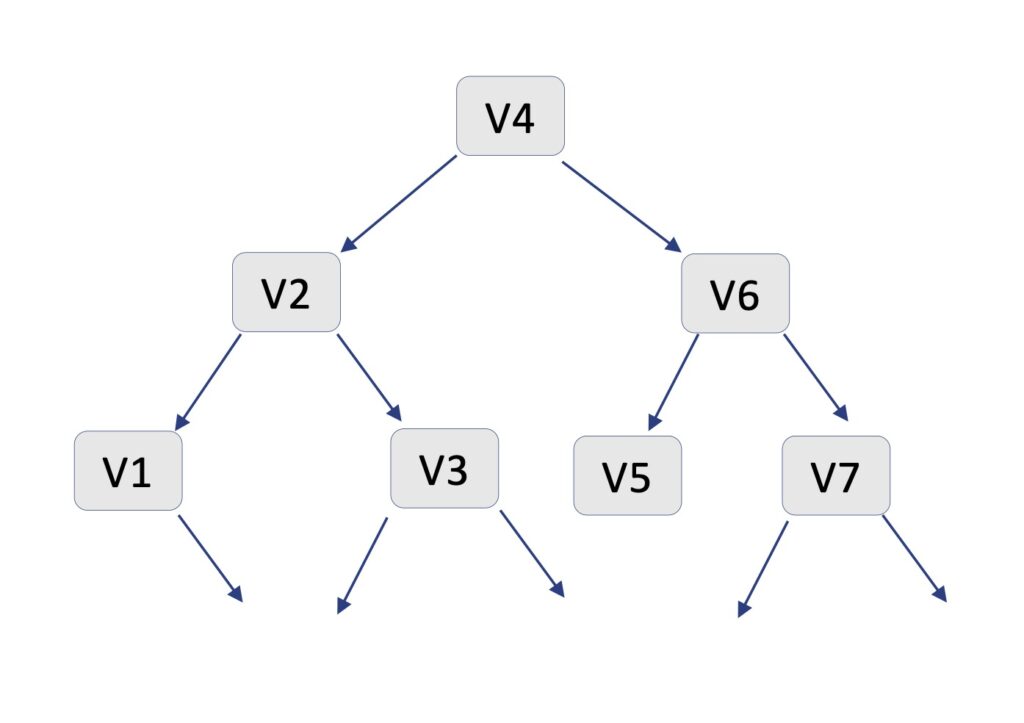
In this example, we define a binary tree where the a node contains a String being the name of a person. First we define class BinarySearchTree:
   class BinaryTree:
      class node(elm: var String):
         left: ref node
         right: ref node
         insert(S: var String):
            if (S <= elm) :then
               if (left == none) :then
                  left := node(S)
               :else
                  left.insert(S)
            :else
               if (right == none) :then
                  right := node(S)
               :else
                  right.insert(S)
         print(ind: var integer):
           ...
      root: ref node
      insert(S: var string):
         if (root == none) :then
            root := node(S)
         :else
            root.insert(S)
      :::
A BinaryTree has the following attributes:
- A local class
Node. - A reference
root, that refers to the root (topNode) of the tree. - A method
insertfor inserting aNodein the tree with the parameterSbeing theStringstored in theNode. It works as follows:- If
root == none, then the insertion is the firstNodeelseroot.insert(S)is invoked.
- If
- A
Nodehas the following attributes: - References
leftandrightthat refer to the left and right branches of theNoderespectively. - An
insertmethod that works as follows:- If
S <= elmwhereelmis the name in the currentNode, thenSis inserted in the left branch.- If
left == nonethenSis the first element in the left branch andleft := Node(S)is executed otherwiseleft.insert(S)is executed recursively.
- If
- If
S > elmthenSis inserted in the right branch.
- If
- A print
methodnot shown.
When a Node is inserted into the tree it is ordered based on a lexicographical ordering. I.e. “Dave” comes before “John” (“Dave” < “John”).
Preliminary figure
We may then declare two BinaryTree objects and insert some elements into them:
boys: obj BinaryTree
girls: obj BinaryTree
boys.insert("Peter")
girls.insert("Cecilie")
girls.insert("Maria")
boys.insert("Robin")
...
Next we add a coroutine, theScanner, that traverse the tree and for each node in the tree, it suspends execution and returns the value at the node. If the tree has n nodes it returns a sequence of String values where V1 <= V2 <= V3 <= ... <= Vn.
   class BinaryTree:
      -"-
      theScanner: obj
         CV: var String
         next -> V: var String:
            resume(theScanner)
            V := CV
         scan(current: ref node):
            if (current =/= none) :then
               scan(current.left)
               CV := current.elm
               theScanner.suspend
               scan(current.right)
         theScanner.suspend
         scan(root)
         CV := ""
         theScanner.suspend
      next -> V: var String:
         V := theScanner.next
Finally we may add a method, merge that merges the values of two binary search trees:
   merge:
      nextBoy: var String
      nextGirl: var String
      tail(T: ref BinaryTree):
         cycle
            S: var String
            S := T.next
            if (S = "") :then
               leave(tail)
            :else
               S.print
      nextBoy := boys.next
      nextGirl := girls.next
      loop: do
         if (nextBoy <= nextGirl) :then
            if (nextBoy = "") :then
               nextGirl.print
               tail(girls)
            :else
               nextBoy.print
               nextBoy := boys.next
               restart(loop)
         :else
            -- nextBoy > nextGirl
            if (nextGirl = "") :then
               nextBoy.print
               tail(boys)
            :else
               nextGirl.print
               if (nextBoy.length > 0) :then
                  nextGirl := girls.next
               restart(loop)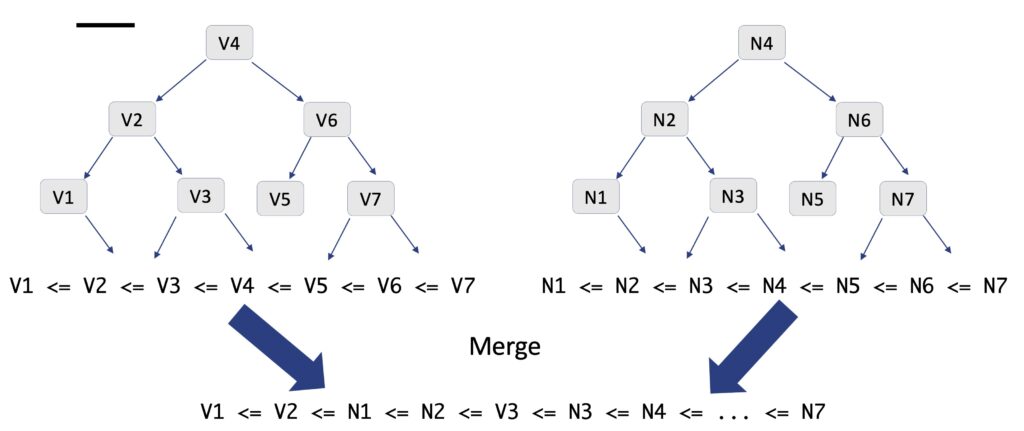
The merge method works ass follows:
- The statements:
nextBoy := boys.nextandnextGirl := girls.nextassigns the first boy and first girl tonextBoyandnextGirlrespectively where the ordering is alphabetical. - If
nextBoy <= nextGirl, thennextBoyis printed andnextBoyis assigned the next boy from the tree usingboys.next. - If
nextBoy > nextGirl, thennextGirlis printed and assigned the next girl. - This is repeated until no more boys and girls in the trees.
- The termination condition is that the empty string (
"") is returned bynextif no more girls/boys in a tree. - if the boys tree becomes empty before the girls tree, then the method invocation
tail(girls)prints the remaining girls in the tree – similarly if the girls tree becomes empty before the boys tree.